June to July 2017
Crans-Montana Conference Fails
The UN conference at Crans-Montana, Switzerland, closes on 7 July 2017 without a deal, split above all over security, guarantees and Turkish troops.
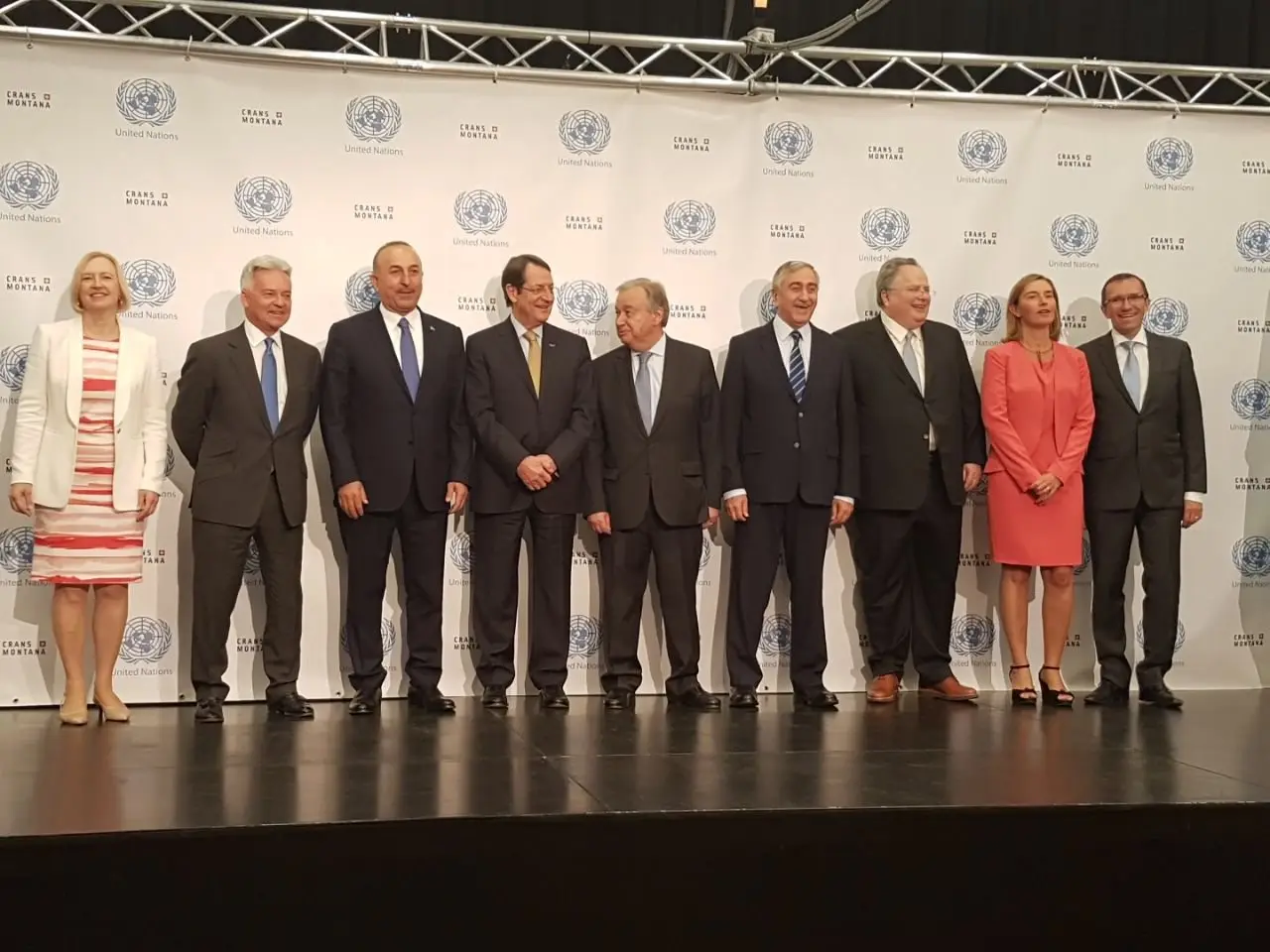
By 2017 the leaders of the two communities, Nicos Anastasiades and Mustafa Akıncı, had been negotiating for almost two years. At a conference in Geneva in January they exchanged maps of a future internal boundary for the first time, and the UN said the broad outline of a federation with political equality was largely agreed. What remained were the hardest questions, and the parties decided to tackle them all at once.
The Conference on Cyprus opened at Crans-Montana, a Swiss mountain resort, on 28 June 2017. Around the table were the two Cypriot leaders, the foreign ministers of the three guarantor powers (Greece, Turkey and the United Kingdom) and the European Union as an observer, with a UN team led by Special Adviser Espen Barth Eide. On 30 June Secretary General António Guterres set out a framework of six areas: security, troops, territory, property, equivalent treatment of Turkish and Greek nationals, and power sharing, including a rotating presidency.
Security proved the hardest. Guterres argued that the 1960 Treaty of Guarantee and its right of intervention should be replaced by a new system, with Turkish troop numbers falling sharply from the first day and then reaching an agreed level on an agreed timetable. The parties still disagreed over whether Turkey should keep any security role in a reunited Cyprus, and over whether a deal should carry a review or sunset clause on troops. Territory, especially around Morphou (Güzelyurt), property rights and the rotating presidency were also open.
Guterres returned to Switzerland to try to rescue the talks, but after a final session of about 15 hours he closed the conference at around 3.15 in the morning of 7 July. He said he was “deeply sorry” that an agreement had not been possible. Each side blamed the other. In his later report Guterres called it a missed historic opportunity and did not assign blame.
No formal negotiations have resumed since. Nine years later, in July 2026, Guterres travelled to Cyprus himself, still looking for a way back to the table.