c. 1550 to 1570
Venetian Fortification Programme
Facing the Ottoman threat, Venice rebuilds the defences of Famagusta and Kyrenia, then encircles Nicosia with new star shaped walls from 1567.
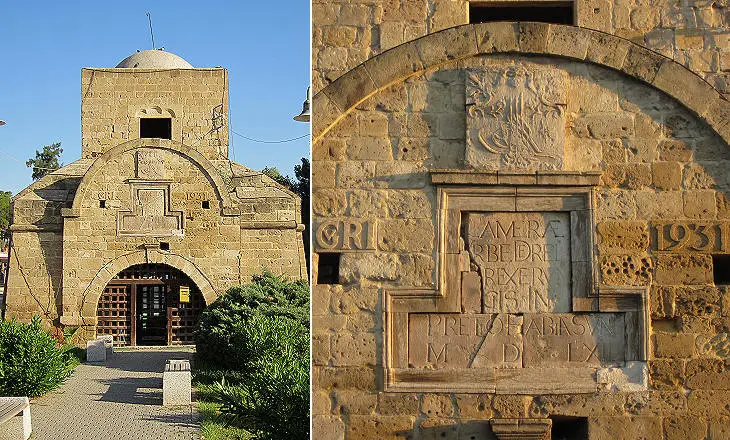
When Venice took over Cyprus in 1489, it inherited medieval defences built for a world of siege towers and crossbows. Gunpowder artillery had made high, thin walls dangerous rather than protective. Cyprus also sat close to the expanding Ottoman Empire, which after 1517 controlled Syria and Egypt as well as Anatolia. Venice responded by rebuilding the island’s main strongholds in the new angled bastion style developed in Italy.
Work began at Famagusta (Gazimağusa), the main port, soon after the takeover; Britannica dates the rebuilt Sea Gate to 1492. The defences were steadily thickened and remodelled, and the old Lusignan citadel, later called Othello’s Tower, was modernised. Around 1550 the engineer Giovanni Girolamo Sanmicheli, nephew of the Veronese architect Michele Sanmicheli, arrived on the island. He designed the Martinengo Bastion, an advanced design later copied elsewhere, and died in Famagusta in 1559 with work still in progress. The finished circuit had fourteen bastions and two gates. At Kyrenia (Girne), the Venetians rebuilt the castle to withstand cannon, replacing older towers with thick round ones.
Nicosia (Lefkosia, Lefkoşa) came last. Governors had long warned that the capital was exposed, but little was done until the Ottoman siege of Malta in 1565 sharpened fears. In 1567 Venice commissioned Giulio Savorgnan and Francesco Barbaro to design new walls. The old city was cut down to a compact circle about 5 kilometres round, with eleven pentagonal bastions named after the noble families who helped pay for them, and three gates: Paphos, Famagusta and Kyrenia. The Pedieos river was diverted to fill the moat.
The cost to Nicosia’s people was high. To clear a field of fire, buildings outside the new line were demolished, including, by one account, about 1,800 houses, 80 monasteries, and a Lusignan royal palace.
The walls were still unfinished when the Ottoman army arrived in July 1570. Nicosia fell on 9 September 1570. Famagusta held out for eleven months before surrendering in August 1571. The Venetian walls of both cities still stand and remain among the most recognisable landmarks in Cyprus.