19 February 1959
Zurich and London Agreements
Greece and Turkey agree a settlement in Zurich, accepted in London by Britain and both Cypriot leaders: independence, with union and partition ruled out.
By late 1958 every party had reason to want a way out. EOKA’s campaign had lasted almost four years, the intercommunal killings of that summer had shocked both communities, and the dispute was straining relations between Greece and Turkey. Britain’s Macmillan Plan had been rejected by Greece and the Greek Cypriots. In December 1958 the Greek and Turkish foreign ministers began talking directly, and independence was discussed seriously for the first time.
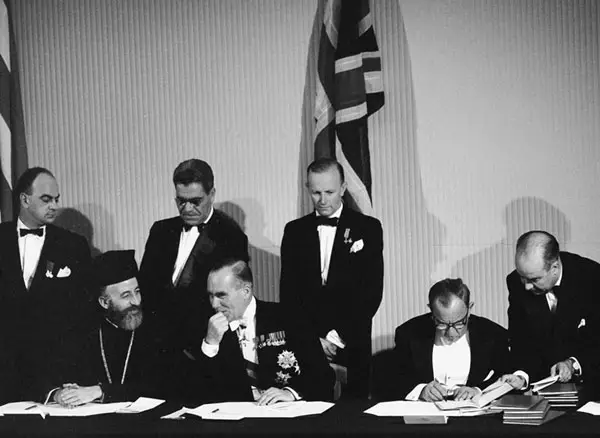
From 6 to 11 February 1959 the prime ministers of Greece and Turkey, Konstantinos Karamanlis and Adnan Menderes, met with their foreign ministers at the Dolder Hotel in Zurich. On 11 February they announced an agreement and passed the text to the British government. A conference opened at Lancaster House in London on 17 February, bringing together Britain, Greece, Turkey, Archbishop Makarios for the Greek Cypriots and Dr Fazıl Küçük for the Turkish Cypriots. Makarios raised objections, but accepted the package when Greece did not support him. Agreement was reached on 19 February 1959.
The settlement had three treaties at its core. The Treaty of Establishment set out the two Sovereign Base Areas Britain would keep, at Akrotiri and Dhekelia, about 256 square kilometres in all. The Treaty of Alliance allowed Greece and Turkey to station 950 and 650 troops respectively on the island. The Treaty of Guarantee bound Britain, Greece and Turkey to uphold the republic’s independence and constitution and banned both union with another state and partition. Under its Article IV, if joint action proved impossible, each guarantor reserved the right to act alone to restore the arrangements it created.
The agreed basic structure of the constitution gave the presidency to a Greek Cypriot and the vice presidency to a Turkish Cypriot, each elected by their own community and each holding a veto. Seats in parliament and posts in the civil service were divided 70 to 30, the army 60 to 40, and some laws needed separate majorities in both communities.
The settlement ended the emergency and ruled out both of the goals the two communities had been fighting for. It had been negotiated mainly between Greece and Turkey, with the Cypriot leaders brought in only at the final stage. Within five years the constitution had broken down.
Sources and further reading
- US Department of State, Foreign Relations of the United States 1958 to 1960, Vol. X: Editorial note on the Zurich talks
- Wikipedia: London and Zürich Agreements
- Library of Congress Country Studies (via countrystudies.us): Cyprus, The Emergency
- Library of Congress Country Studies (via countrystudies.us): Cyprus, Independence